A plant sends samples to the lab every month, gets clean results and closes the file. Then a request comes in from a retail customer for a certificate on pesticide residues in the raw material, and it turns out that none of the tests performed so far ever touched that. The tests were microbial, and the question now being asked is purely chemical. The two families of tests answer different questions, and anyone who knows only one of them is running half a monitoring program.
What a Chemical Test Finds That a Microbial Test Misses
A microbial test asks who is living in the product: Salmonella, Listeria, E. coli, total bacterial count, yeasts and molds. It reflects production hygiene and the product's stability over its shelf life.
A chemical test asks a different question: what the product is made of, and what got into it that was not supposed to. It does not look for a living organism but for a substance. A residue of a pesticide left on the vegetable from the field, a metal that accumulated in a fish over its lifetime, a trace of a cleaning agent that was not rinsed off the line, an allergenic protein that carried over from one product to another.
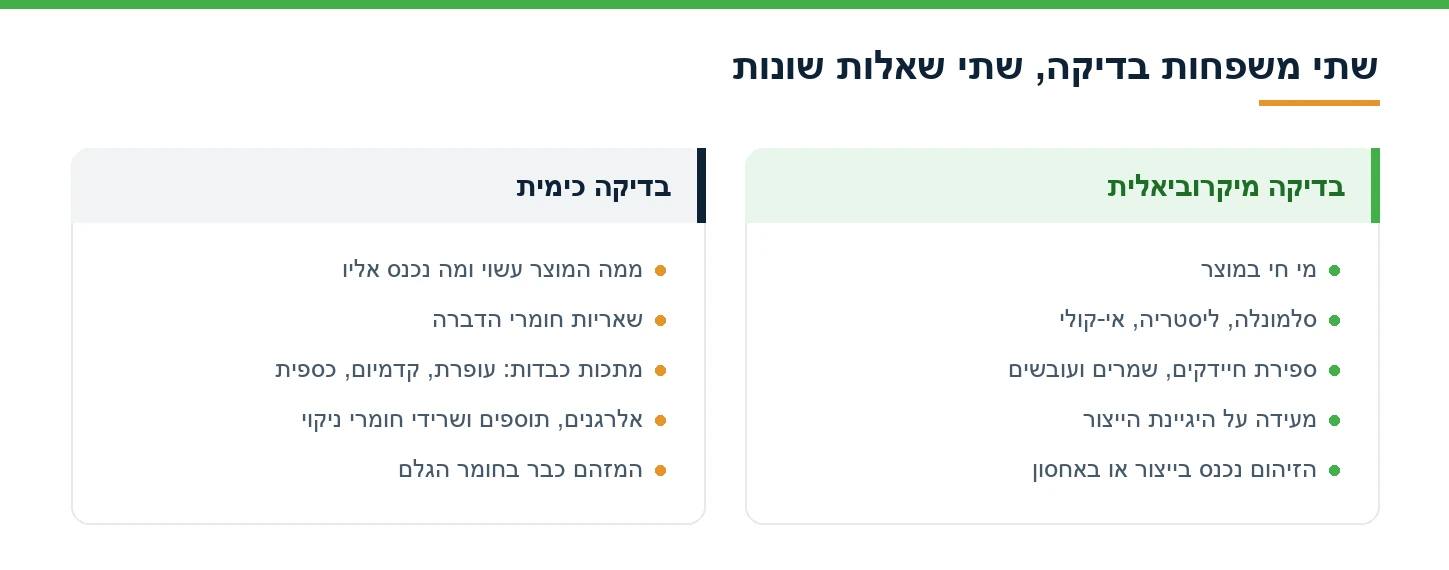
The practical difference is timing. Microbial contamination usually enters the product during production or storage, so environmental monitoring and process control catch it. A chemical contaminant is most often already in the raw material the moment it reaches the plant gate. Nothing that happens on the line will take it out.
Pesticide Residues: What the Regulations Actually Say
The regulations that govern this in Israel are the Public Health Protection (Food) (Pesticide Residues) Regulations, 5751-1991, enacted under the Public Health Ordinance (Food) [New Version], 5743-1983, and under the Plant Protection Law, 5715-1955.
The wording of the prohibition is sharp: "A person shall not produce for sale, import or market food that contains or bears a residue, unless its level does not exceed the permitted level."
Note what it says. The prohibition does not apply only to production. It applies to import and to marketing as well. An importer whose shipment has crossed the border, and a distributor who passed the product on, bear the same obligation as the producer.
The permitted levels themselves are set in the schedules to the regulations, in parts per million, and vary from substance to substance and from food category to food category. The same preparation may be permitted at one concentration in a fruit and at an entirely different concentration in a leafy vegetable. That is why a pesticide-residue test is always built around the type of product, and not as a generic list of substances.
Heavy Metals: How They Enter the Product
Heavy metals do not reach food because of a fault on the line. They come from the environment in which the raw material was grown.
Lead, cadmium, mercury and arsenic enter a plant through the soil and the irrigation water, and an animal through the food it eats. In fish this process is especially pronounced, because mercury accumulates along the marine food chain and its concentration rises the larger and more predatory the fish. For that reason large fish are tested separately from small fish, and from other food products.
The test itself identifies the metal and its concentration in the product. For a plant that buys raw material from changing suppliers, this is usually the test that justifies itself the first time a new supplier enters the picture.
Allergens, Additives and Cleaning-Agent Residues
Three further categories fall under the same umbrella, and each of them comes from a different place in the process:
- Allergens. Gluten, nuts, milk, egg, soy, sesame. The main risk is cross-contamination on a shared line, where residues from a previous product carry over to a product whose label does not declare them.
- Food additives and preservatives. Here the question is whether the actual concentration matches what appears on the label and what is permitted.
- Cleaning and sanitation residues. After a line is washed, residues of the agent itself can remain on contact surfaces and carry over to the first batch that runs after it.
The third category is the one most often forgotten, because it comes neither from the field nor from the supplier but from the cleaning process that was supposed to protect the product.
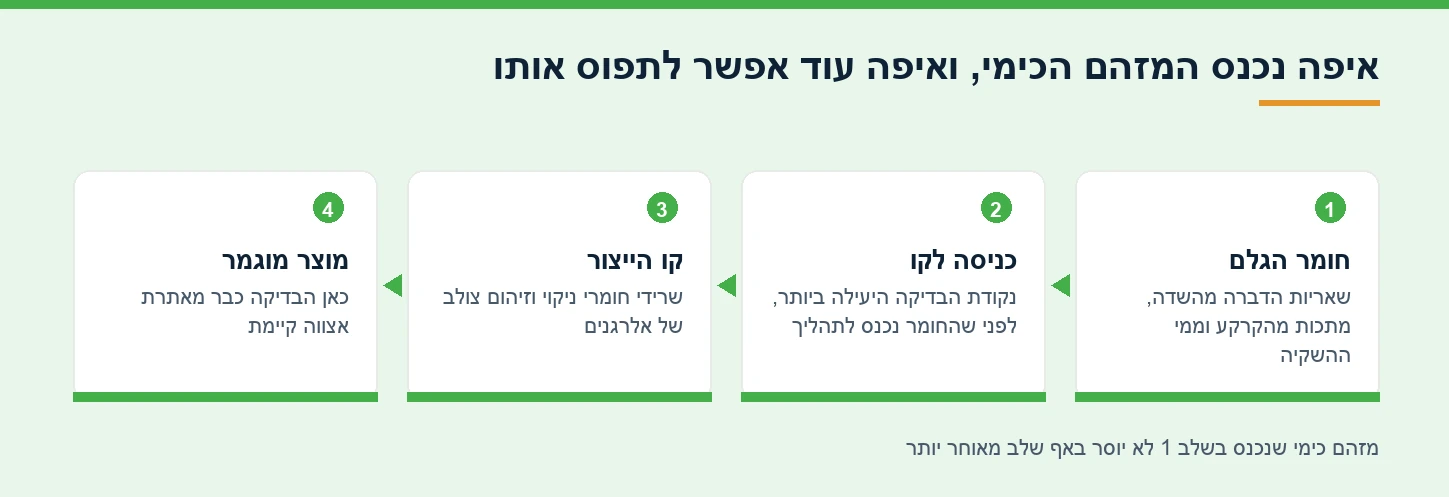
How to Build Chemical Testing into the Sampling Program
A chemical test does not replace a microbial test and does not run at the same frequency. It is built around the entry points of the risk:
- A new supplier. Raw material from a source not tested before, especially fresh produce or fish.
- A product moving to export or a retail chain. The buyer's documentation requirements usually precede the regulatory ones.
- A change to the line or the sanitation protocol. A new cleaning agent justifies a residue test after cleaning.
- Release of an imported shipment. Here the test is a practical condition for release, not an internal control tool.
The process is the same as for any other sample: field collection by a certified sampler, transport under suitable conditions and a documented chain of custody, testing at an ISO 17025 accredited laboratory and a results report. We build your food testing for plants with you, by product type and the line's risk map, so that the chemical tests fit into the existing program and are not run as a separate event.
For businesses where the food arrives already packaged from an external source, the logic is different. There the focus is food testing for importers, intended to confirm that a shipment complies before the regulator, prior to it continuing to market.
Frequently Asked Questions
Does a clean microbial test mean the product is safe?
It means the product is safe microbially only. Pesticide residues, heavy metals and allergens are not detected by a microbial test and require a separate chemical test. A product can pass the first and fail the second.
Who is required to test for pesticide residues?
The regulations prohibit producing for sale, importing or marketing food whose residue exceeds the permitted level. The obligation applies to all three links: the producer, the importer and the distributor.
At what stage should raw material be tested?
At entry to the line, before the material goes into production. A chemical contaminant already present in the raw material will not be removed at any later stage, so a test after production detects the problem once the batch already exists.
Does every substance need to be tested in every test?
No. The test panel is built according to the product type, the source of the raw material and the relevant regulatory or commercial requirement. A generic test of every preparation is expensive and usually unnecessary.
A plant that monitors only bacteria sees half the picture. Chemical risk enters through the raw material, through the environment in which it was grown and through the cleaning process, and it is not caught by any of the microbial tests the plant already runs. We will build a food sampling and testing program with you that covers both families, sample in the field through certified samplers and return a clear report with recommendations, nationwide.
To schedule food sampling, call 08-9332299You can also reach us on WhatsApp or leave your details for a callback