
Food Testing for Restaurants and Catering - What's Required
Which food and surface tests a food business needs, how often, and why it is critical.
Read MoreMicroorganisms are invisible to the eye, yet they are what determine whether the food leaving the kitchen or the production line is safe to eat. Microbial testing is the accepted tool for detecting them before the product reaches the consumer, and it is a permanent layer in every quality-control program in the food industry. Here we have gathered what is actually tested, what each test says about the production process, and why the way a sample is taken matters no less than the test itself.
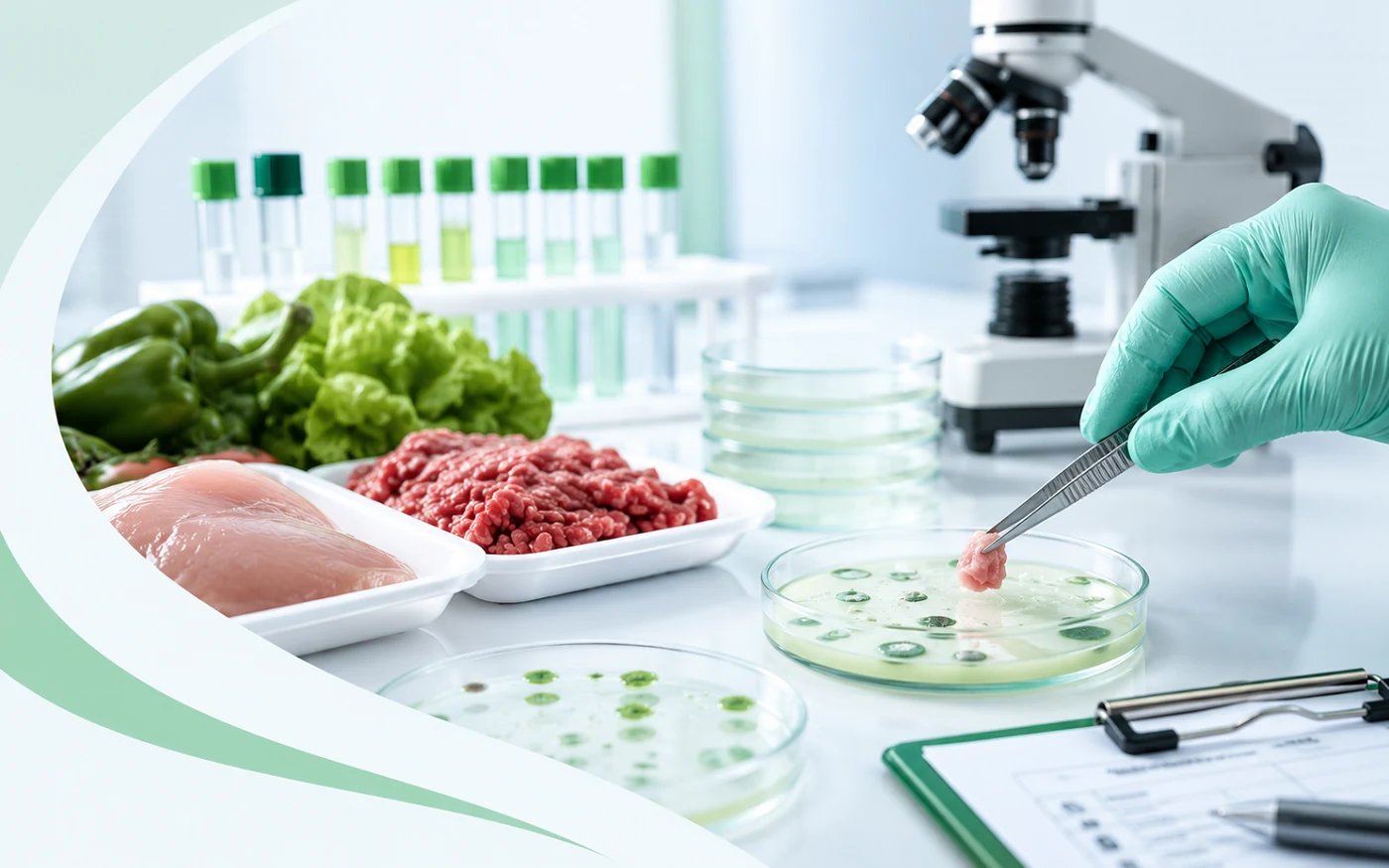
A microbial test is a laboratory test designed to identify, quantify or rule out the presence of microorganisms in a food sample. Unlike a chemical test, which looks for a specific substance, here you are looking for living organisms that multiply - and so both the quantity found and their mere presence carry meaning.
The four main families of findings that the tests cover:
Combining these findings makes it possible to answer two questions: whether the product meets the standard's requirements, and whether something in production, storage or transport did not work as it should.
There is no single list of tests that fits everyone. The types of tests derive from the product type, the production method, the Ministry of Health's requirements and the business's quality-control program. More on the test panel common in the industry can also be found on the website of the Israel Public Health Association, one of the longest-standing bodies in Israel in the field of food laboratory testing. These are the tests that recur in most programs:

One of the best-known names in the world of food safety. Salmonella is associated mainly with poultry, eggs and meat, but it also appears in other products along the supply chain and can cause food poisoning. For that reason it is tested almost always in products from these risk groups.
The bacterium that demands the greatest attention in ready-to-eat products. Unlike most bacteria, Listeria survives and even multiplies at refrigeration temperatures, so keeping the cold chain is not enough to neutralize it. In plants that produce such products it is customary to monitor both the product and the production environment on a regular basis.
A group of bacteria whose species are mostly found naturally in the digestive system, but some strains are pathogenic. Finding them in a food sample is usually a sign of contamination from a fecal source or of a sanitary failure in the process, which is why they serve as one of the important indicators of hygiene quality.
A test that does not look for a specific bacterium but measures the total microbial load in the product. A high value does not necessarily indicate a health hazard, but it is a red flag about the level of cleanliness, the freshness of the raw materials or the storage conditions - and justifies a more in-depth test.
Factors that affect mainly the product's stability and its shelf life. An abnormal finding here is usually detected before the consumer notices a problem, and makes it possible to correct storage or packaging conditions in time.
The common mistake is to see laboratory tests as an emergency tool, triggered only after a customer complaint or an inspector's finding. In practice, their main value is obtained precisely in routine: periodic sampling creates a baseline that makes it possible to spot a deviation at an early stage, while it is still small and correctable.
When an inspection, a complaint or a retail chain's requirement arrives, a series of clean results over time is the objective evidence that the business works correctly. A business that starts testing only after the event is left with no point of reference.
Food safety is determined long before the product is packed. A recurring source of contamination often hides not in the dish itself but in a work surface, a crevice in a machine, a cutting tool or a drain point - and testing the finished product alone will not always reveal it.
That is why comprehensive control programs also include environmental sampling in food plants: taking samples from surfaces, equipment and production areas, intended to verify that the cleaning and disinfection processes are indeed effective and to detect contamination hot spots before they reach the food.
A good laboratory result begins long before the laboratory. The reliability of the test depends to a large degree on how the sample was taken, and a sample that was compromised along the way will yield a result that does not reflect the product's condition - either too strict or too lenient.
Any deviation at one of these steps can change the result, which is why it is important that the sampling be carried out by a professional, skilled party and not as a side task of one of the kitchen staff.
Almost every body that touches food on its way to the consumer: food plants and manufacturers, restaurants and cafes, catering companies, institutional kitchens in hospitals and nursing homes, hotels and event halls, food importers and retail chains. The scope of the program varies according to the nature of the activity and the level of risk: food testing for restaurants and catering will look different from the program of a plant producing ready-to-eat products on a national scale.
A sampler on our behalf arrives at the business anywhere in the country, takes the samples according to the product type and the purpose of the test, documents the sampling details and transports them under controlled conditions. The samples are forwarded to accredited and recognized laboratories to perform the relevant tests, and you receive a clear result with a comparison to the threshold values.
If the result is out of range, we do not stop at the report: you can continue to a test of the contamination source, to a cleaning and disinfection process and to verification sampling that confirms a return to routine. For a full breakdown of the types of tests and the solutions for businesses in the sector, visit the food sampling and testing page.
Leave your details and we'll get back to you with a professional answer and a tailored sampling plan, or talk to us now by phone or WhatsApp.
Which food and surface tests a food business needs, how often, and why it is critical.
Read More
What the accreditation means, how it ensures reliable results and why the regulator requires it.
Read More
The steps for handling a contamination event - from the report to the verification sample that confirms a return to routine.
Read More