A food business can involve quite a few professionals: a food consultant, a sanitarian, a quality manager, a sampler and the laboratory that runs the tests. Each has a different role, but in the end they are all trying to answer the same basic question: is the food produced, stored and served here safe, and does it meet the requirements that apply to it?
A food consultant can help a business plan its processes, food safety, HACCP, sanitation and readiness for regulatory requirements. At some point, though, you have to move from procedures and plans to what is actually happening on the ground.
This Is Where Food Sampling and Food Testing Come In
A sample taken from a product, a raw material or the work environment and sent for testing provides information you cannot get just by looking. It can help detect bacteria, assess chemical parameters, check for contaminants and various components, and show whether the business's control processes are doing their job. That is exactly the role of professional Food Sampling.
But a good food test starts long before the sample reaches the laboratory.
A Food Consultant Recommended a Test. What Happens Now?
A recommendation to run food tests is only the beginning of the process.
You need to understand what you want to test, which product or raw material is the right one to sample, where the right sampling point is, how the sample should be taken, how it should be kept and which test it should be sent for.
For example, a food plant that wants to check a finished product is not in the same position as a restaurant that wants to test a prepared dish. A suspected contamination event is also very different from a routine sampling plan designed to monitor day-to-day work processes.
So "food testing" is not a single action that suits every business and every product.
The type of test should be derived from the product, from the production or preparation process and from the reason the test is being done.
Food Sampling Is an Integral Part of Test Quality
When people think about food testing, it is easy to focus on the laboratory. In practice, one of the most important stages happens at the business itself.
Food sampling is a controlled process of taking a sample that represents, as closely as possible, what you want to test.
The way the sample is taken matters, as do the sampling tools, the documentation, the storage and the way the sample is delivered to the laboratory. Where the right temperature has to be maintained, for example, transport is also part of the process.
The goal is simple: the sample that reaches the laboratory should produce a result that is genuinely useful to the business.
Kesar Digum comes to your premises, takes the samples according to the type of test required, documents them, delivers them to accredited laboratories and sends the client the test results in an organized, professional and fast way.
Certified Samplers and ISO 17025 Accredited Laboratories
A food test result is only as good as the chain that led to it. That is why every stage of our process rests on accreditation:
- Certified samplers: samples are taken on site by samplers certified by the Ministry of Health, following orderly sampling, labeling and documentation procedures.
- Chilled transport: samples are transported chilled from the sampling point until they reach the laboratory.
- ISO 17025 accredited laboratories: testing is carried out in laboratories that meet the demanding ISO 17025 standard, the international standard for the competence of testing laboratories.
- Accreditation and official recognition: testing is performed under the accreditation of the Israel Laboratory Accreditation Authority and with the recognition of the Ministry of Health.
For your business, that means a report you can rely on and present to inspectors, customers and retail chains.
Which Food Tests Can Be Performed?
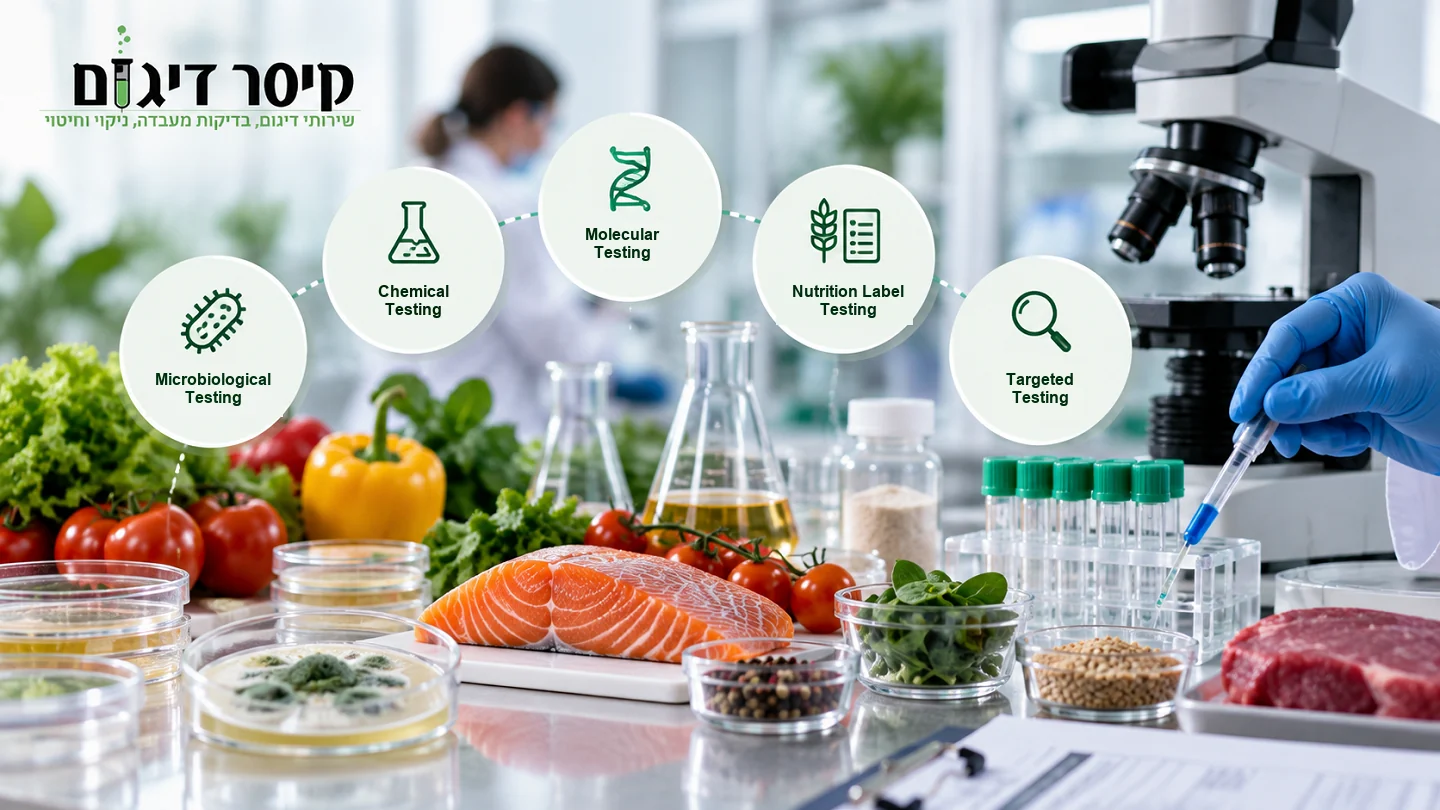
The term food testing covers a wide range of tests, and the choice between them depends on the question the business needs answered.
Microbiological tests are used, among other things, to detect relevant microorganisms and pathogens and to assess indicators that can point to the condition of the product or the hygiene of the process. Depending on the product and the need, tests can cover, for example, Salmonella, Listeria, E. coli, Staphylococcus, Bacillus cereus, yeasts and molds, and other microbial indicators.
Alongside them are chemical tests that can examine food composition, ingredients and various parameters, as well as the presence of contaminants where needed. Molecular tests, tests related to nutrition labeling and targeted tests are also available when there is a suspected foreign body, a change in the product or another problem that needs investigating.
The key point is that you do not start from the list of possible tests. You start from what the business needs to know.
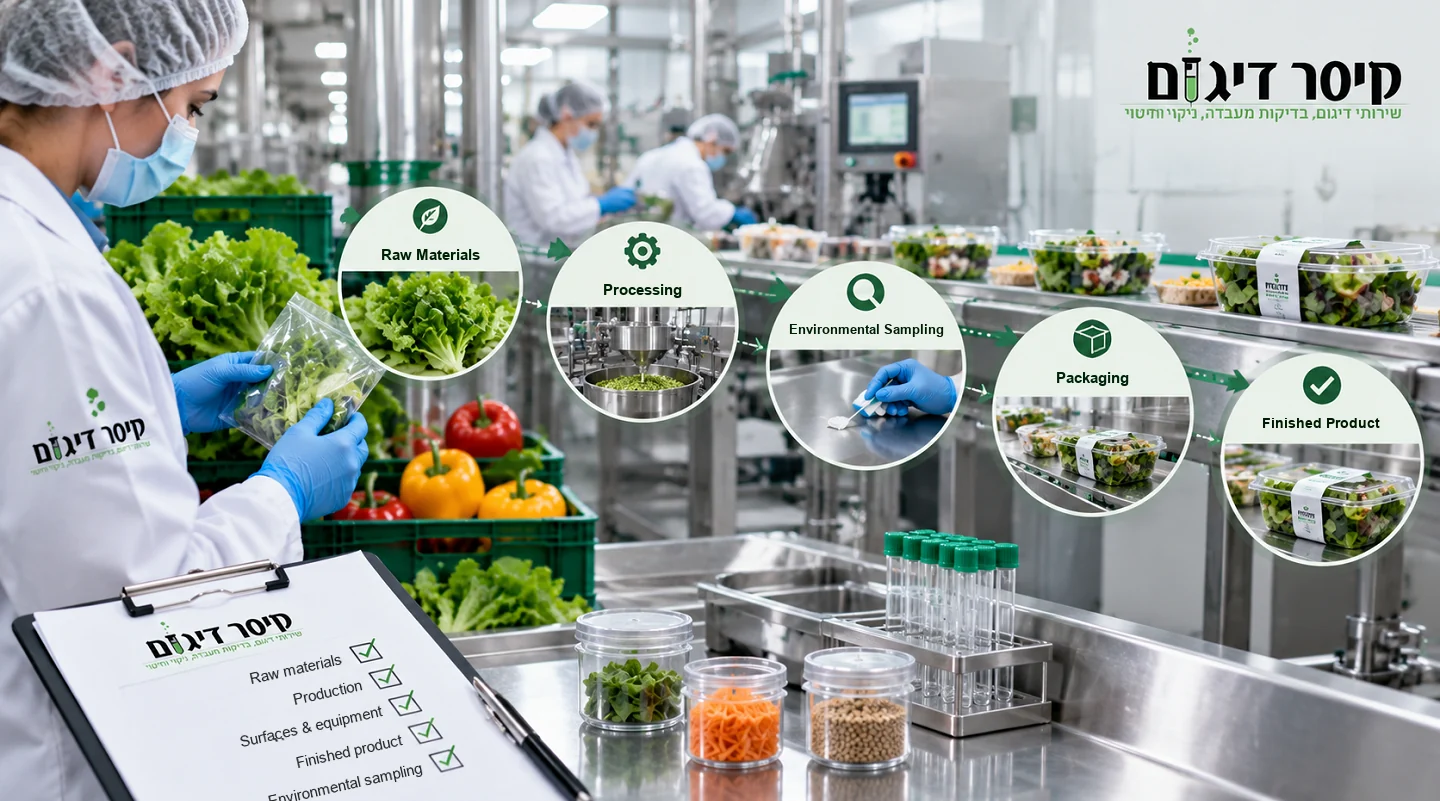
Food Testing for Plants Starts Long Before the Finished Product
In a food plant, the finished product is just one point in a long chain.
Raw materials enter the plant, are stored, prepared and processed, come into contact with machinery and surfaces, are packaged and finally leave as a finished product.
So food testing for plants may include sampling raw materials and products at different stages, alongside testing of the final product. The testing plan can be integrated into the plant's quality control system and HACCP plan, according to its needs and the relevant requirements.
And there is another important point: sometimes the product where the problem shows up is not where the problem started.
If, for example, a product keeps returning an abnormal result, it may be necessary to examine the production environment as well. Environmental sampling in food plants makes it possible to test surfaces, equipment and different areas of the work environment and try to identify spots that may be linked to the contamination.
In other words, testing the product can show that there is a problem. Testing the production environment properly can help you understand where to look for its source.
Food Testing for Restaurants and Catering, From the Plate Back to the Kitchen
In a restaurant or catering company the workflow is different from a plant's, but here too there are many points that need control.
Raw materials are received and stored, food is prepared and cooked, some items are kept chilled or hot, staff and equipment come into contact with the food, and finally the dish reaches the diner.
So food testing for restaurants and catering can include, as needed, sampling of prepared dishes alongside sampling of work surfaces and tests related to the hygiene of the work environment.
The advantage of periodic testing is that it does not necessarily wait for a problem you can see or smell. Food can look perfectly fine and still contain something that cannot be detected without the right test.
We Have the Lab Results. Now the Important Part Begins
One common mistake is to treat the lab report as the end of the process.
In practice, the result is a decision-making tool.
When the results are normal, they can feed into the business's monitoring and quality control system. When an abnormal result comes back, you need to understand what was found, where the sample was taken and what the finding means for the product and the process.
In some cases it will be necessary to examine raw materials, surfaces, equipment, cleaning methods, storage or other stages of the process. Depending on the case, additional sampling may also be needed.
The goal is not just to get a "pass" or "fail", but to use the result to understand what needs to happen next.
Bacteria Found? The Test Should Not End With the Report
When a food test or environmental sampling points to contamination that requires treatment, time becomes a significant factor.
The business needs to deal with the finding and the relevant areas and act to reduce the risk of the contamination continuing. In that situation, there is a real advantage when the company providing the sampling services can also handle the next step.
Kesar Digum also provides professional cleaning and disinfection services when needed, where contamination is found that requires treatment on site.
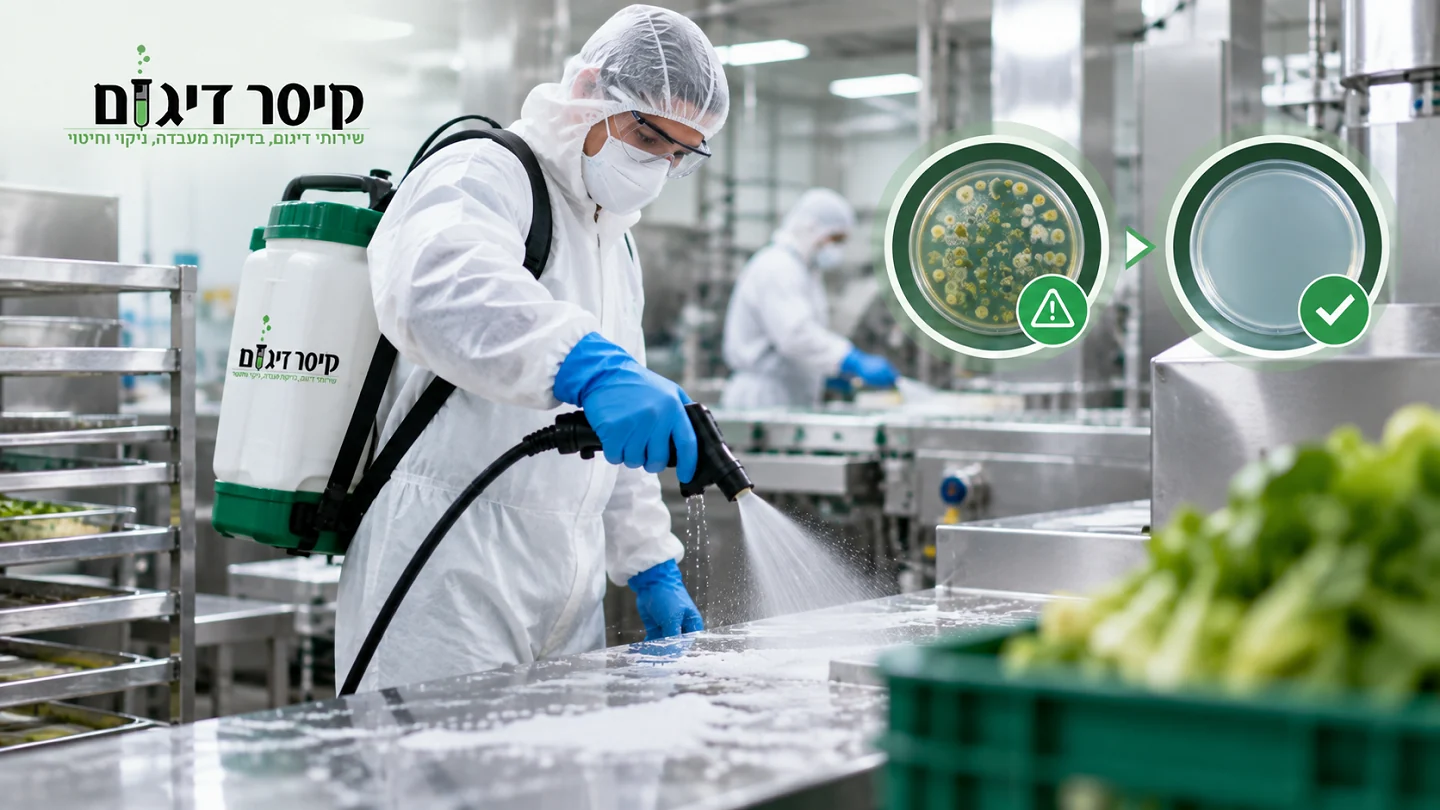
Treatment can be tailored to the findings and the work environment and cover the relevant areas, surfaces or equipment, using approved materials. After cleaning and disinfection, follow-up sampling can be carried out as needed to get an up-to-date picture after treatment.
For a plant, restaurant or catering company, this means you do not have to stop at "what did the lab find?" and can move on to the more important question: what do we do about the finding?
We provide solutions for water, food, air and environmental quality control, and in the food sector we offer a full range of sampling and testing services for manufacturing plants, restaurants, catering companies, institutional kitchens, importers and other businesses in the industry. Importers can read more about Food Testing for Importers.
Samples are sent for testing to ISO 17025 accredited laboratories, and testing is performed under the accreditation of the Israel Laboratory Accreditation Authority and with the recognition of the Ministry of Health.
Good Food Testing Starts With the Right Question
Food testing is not something you do just to get a certificate and file it away.
When you choose correctly what to test, carry out professional food sampling with certified samplers, maintain the right conditions for the sample and its transport, run the appropriate test in an accredited laboratory and take the results seriously, testing becomes part of the business's quality control system.
And sometimes it is precisely an abnormal result that provides the most important information. It lets you identify that there is a problem, look for its source, deal with it and check that the situation has changed after treatment.
Need Food Sampling or Food Testing for Your Business?
Kesar Digum provides food sampling and food testing services for plants, restaurants, catering companies, institutional kitchens, importers and businesses in the food sector, nationwide.
Our team comes to your premises, carries out the sampling on site with certified samplers, handles documentation and chilled transport of the samples to ISO 17025 accredited laboratories and returns the test results professionally and quickly, with a clear report and recommendations. If contamination requiring treatment is found, you can also get professional cleaning and disinfection services and, as needed, follow-up sampling.
Want a sampling plan that fits your business exactly? We will build a sampling and testing plan with you, based on your products, processes and the requirements that apply to you.
To schedule a service or ask a question, call 08-9332299You can also reach us on WhatsApp or leave your details for a callback
We'll be happy to help